
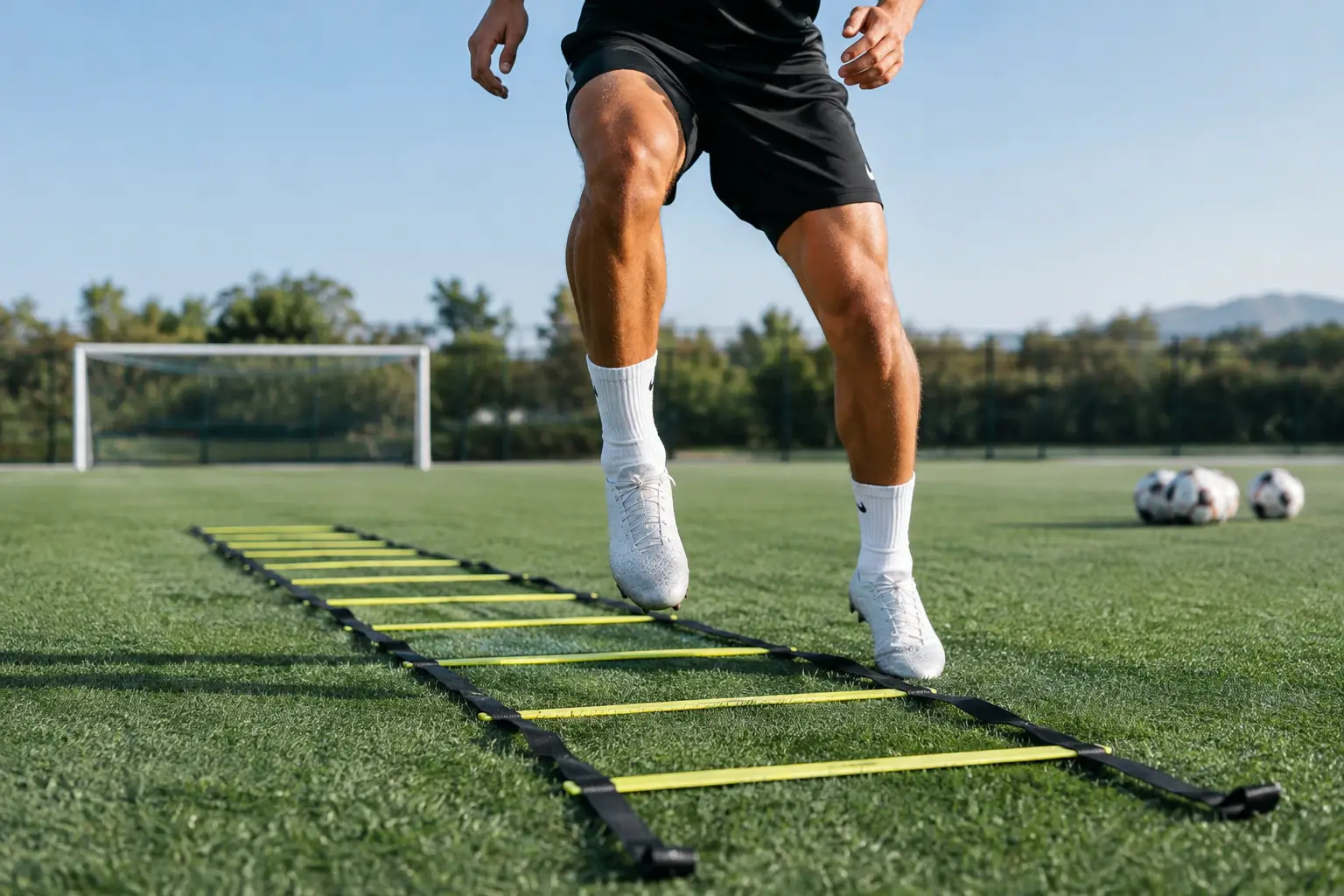
A football agility ladder can expose sloppy footwork quickly. If your feet cross unnecessarily, your hips rise through a change of direction, or you lose balance when accelerating out, the ladder makes it obvious. Used well, it is a simple training tool for better rhythm, body control and movement quality.
Used poorly, it becomes fast feet for the sake of fast feet. Football is not played in neat boxes on flat ground with no ball, opponent or decision to make. The goal is not to collect complicated ladder patterns. The goal is to improve the positions and coordination that help you press, recover, receive, turn and accelerate with control.
What a football agility ladder can improve
A ladder is most useful for teaching players to place their feet accurately while keeping their posture athletic. That means staying light through the forefoot, maintaining a slight knee bend and keeping the hips ready to move rather than standing tall and bouncing.
For younger players, it can build basic coordination and confidence. For academy, club and senior players, it is more about refining movement before higher-speed work. The benefits are usually seen in cleaner deceleration, quicker first steps and greater control when changing direction.
There is a limit. A ladder does not fully train agility on its own. True agility includes reacting to a cue: an opponent’s body shape, a loose touch, a teammate’s pass or a coach’s call. Treat ladder work as footwork preparation, then connect it to reactive movement and football actions.
Set up for quality, not exhaustion
Place the ladder on a flat, non-slip section of the pitch or training surface. Give yourself at least five metres beyond the final rung so each repetition can finish with a short acceleration. This matters because the exit is often more relevant to football than the pattern inside the ladder.
Keep early repetitions short. Two to four passes through the ladder with 30 to 45 seconds of recovery is enough when the emphasis is speed and precision. If technique deteriorates, rest longer or stop the set. Training tired, noisy feet teaches tired, noisy movement.
Wear boots suited to the surface and make sure your socks and footwear feel secure. Players who slide inside their boots or lose stability underfoot will compensate through their stride. Secure fit supports sharper movement, especially when the session moves from ladder work into sprints and directional changes.
Football agility ladder coaching cues
The best cue depends on the drill, but a few standards apply across every pattern. Keep your eyes forward where possible rather than staring down at every rung. Use quick, quiet contacts. Let your arms move naturally to support balance. Stay low enough to push away, but do not force an exaggerated squat.
Do not chase maximum cadence from the first repetition. Start at a pace where every foot lands cleanly, then increase speed without changing posture. If a player is clipping rungs, looking down constantly or rocking side to side, slow it down and rebuild the pattern.
A useful standard is this: the drill should look controlled at the start and decisive at the exit. There is little value in rapid foot taps if the player cannot leave the ladder with a strong first three steps.
Four drills with a place in football training
One foot in each square
Run forward with one foot landing in each box. This is the simplest pattern, but it is not a beginner-only drill. Use it to reinforce posture, rhythm and front-side mechanics before acceleration work.
Move through the ladder without reaching your feet too far in front of your body. On the final square, drive out for five metres. For a more football-specific variation, have a coach point left or right as the player exits, then sprint through the indicated gate.
Two feet in each square
Place both feet in every square, leading with one foot and following quickly with the other. This develops rhythm and controlled foot speed while making players maintain a compact base.
Avoid high knees and excessive vertical bounce. The feet should be active, but the body should travel forward smoothly. Alternate the lead foot each repetition so one side does not become dominant.
Lateral two-in, two-out
Stand side-on to the ladder. Step both feet into a square, then both feet out to the far side before progressing to the next square. This pattern challenges lateral coordination and is useful before defensive shuffles and pressing exercises.
Keep the hips and shoulders stable rather than letting the upper body twist through every step. At the end, sprint or shuffle to a cone depending on the movement you want to prepare. A defender might exit into a five-metre lateral recovery; a wide player might exit into a forward burst.
Ickey shuffle with an exit
Move forward with two feet inside the square, one foot outside, then progress into the next square. The sequence requires more concentration than the basic drills and can expose differences between the left and right side.
Use it only once the player can hold posture at speed. It is a coordination drill, not a performance test. Finish with an explosive exit, then add a ball reception on the next repetition if the group can maintain the quality of both actions.
Make the ladder transfer to the pitch
The ladder should be the first part of a movement sequence, not the whole sequence. After a pattern, ask the player to accelerate, brake, react, receive or pass. This is where the footwork becomes useful.
For example, run a two-feet-in pattern, accelerate five metres, decelerate under control and receive a pass on the back foot. Alternatively, complete a lateral pattern, react to a visual cue and close down a cone or teammate. Keep the football action simple enough that the intended movement quality remains clear.
The trade-off is session time. A busy team training night may not allow every player to complete long individual ladder blocks. In that case, use the ladder as part of a station circuit or a five-minute warm-up before sprint and ball work. Players who need extra coordination can add a short individual session once or twice a week.
A practical weekly approach
Two sessions per week is enough for most players. Place ladder work after a general warm-up, when the body is prepared but before fatigue-heavy conditioning or small-sided games. Use one session for clean, repeatable patterns and one for exits, reactions or ball actions.
Across the first two weeks, focus on one-foot and two-foot patterns at a controlled pace. In weeks three and four, add lateral movement and faster exits. Once the patterns are clean, do not keep making them more complicated. Increase the football demand instead: a call from the coach, a coloured cone, a pass, a defender’s pressure or a finishing action.
Players returning from injury should follow their physio or medical professional’s plan. A ladder may be appropriate for low-level coordination work, but it does not replace structured return-to-running, strength or change-of-direction progressions.
Common mistakes that reduce the value
The first mistake is treating every repetition as a race. Speed matters, but only when the player can own the positions. The second is using too many patterns in one session. Three well-executed drills create more value than eight patterns performed once with poor attention.
Another mistake is leaving out the exit. Football rewards what happens after the feet move, whether that is a burst into space, a defensive adjustment or a clean first touch. Build that action into the drill whenever possible.
Finally, do not mistake ladder work for complete agility training. It develops part of the picture. Strength, sprint mechanics, deceleration ability, reactive drills and regular football exposure all contribute to movement that holds up under match pressure.
A football agility ladder earns its place in training when it sharpens the details that support the next action. Keep the patterns clean, make the exit purposeful and carry that control into every sprint, turn and touch on the pitch.