
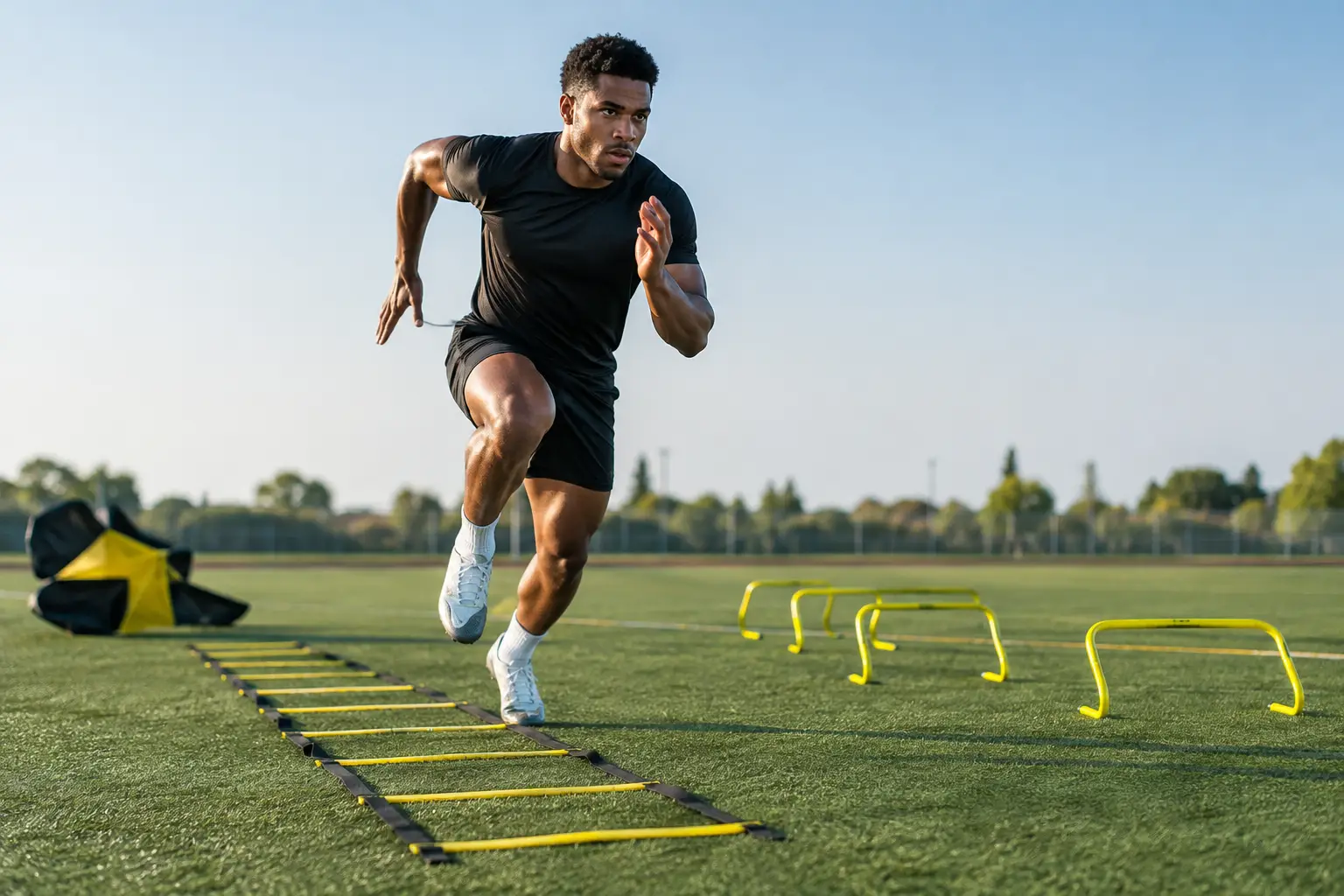
A winger rarely gets a clean 30-metre runway in a match. More often, the decisive action is three hard steps to reach a loose ball, a sharp change of direction, then the ability to repeat it late in the session. The right football speed training equipment prepares players for those moments. The wrong gear simply adds fatigue, clutter and a false sense of progress.
For committed players, speed work should support football movement: acceleration from different body positions, controlled deceleration, efficient changes of direction and repeat sprint capacity. Equipment has a role, but it is not the programme. Choose tools that make quality movement easier to coach, measure and repeat.
What football speed training equipment should do
Every item in a speed kit should answer a practical question. Does it improve the quality of a drill? Does it make the session safer? Does it give the player clear feedback? If the answer is no, it is unlikely to earn space in the kit bag.
Speed is not just top-end running. In football, it includes the first step after scanning, getting low to brake before a tackle, reaccelerating after a cut and staying composed when fatigue builds. That means the best equipment is usually simple, durable and versatile enough to use across individual, small-group and team sessions.
A player who is still learning to control their body under braking does not need heavy resistance. They need room to practise a strong position: hips back, knees tracking cleanly, chest balanced and feet making quick contact with the ground. Add load or complexity only when that foundation holds.
Build the kit around game-relevant movement
A useful speed setup starts with field markers, then adds resistance, reaction and timing tools where they have a clear purpose. There is no need to buy everything at once.
Cones and flat markers for movement quality
Cones are basic, but they remain one of the most effective pieces of training gear. Use them to set acceleration distances, braking zones, curved runs and change-of-direction patterns. Flat markers are especially useful in crowded drills because players can run over them with less risk of catching a foot.
The value is in the setup, not the cone itself. A five-metre acceleration into a controlled stop can reveal far more about a player’s movement than a long, repetitive shuttle. Keep the distances honest. If the aim is first-step speed, use short spaces and full recovery rather than turning the drill into conditioning.
Resistance bands and sprint harnesses
Light resisted sprint work can help players feel a more purposeful forward drive during acceleration. A harness and resistance band may suit a partner-resisted drill, while a sled can provide a more consistent load where space and surface allow it.
The trade-off is obvious: too much resistance changes the running action. If the player is leaning excessively, shortening their stride or grinding through the drill, the load is no longer serving speed. Start light, keep efforts brief and use resistance for acceleration work rather than trying to mimic every phase of sprinting.
For younger academy players, supervised band work is often enough. For senior players with sound mechanics and a structured strength programme, a sled may be a useful addition. Neither replaces coaching or progressive sprint exposure.
Agility poles and hurdles
Poles can create clear lines for curved runs, slalom movements and approach angles. They work well when players need to accelerate around an opponent-shaped obstacle without losing balance. Use them sparingly and make the exit matter. A sharp run around a pole should finish with an acceleration, pass, shot or defensive recovery, not another slow pattern.
Low hurdles can help reinforce rhythm, posture and quick ground contacts. They are not a shortcut to faster feet. High-volume ladder and hurdle routines can look busy while teaching little that transfers to match play. Keep the hurdle height low, the contacts clean and the task specific to the session.
Reaction tools and timing gates
Football speed starts with information. A coach’s call, a coloured cone, a ball release or a teammate’s movement can all create a reaction element that better reflects competition. Simple visual and auditory cues are often enough to stop players from rehearsing a movement before they have to make it.
Timing gates are valuable when used consistently. They can track progress over short acceleration distances, flying sprints or repeat efforts, removing guesswork from speed work. A stopwatch can still be useful, but hand timing carries more variation. If players are chasing numbers, make sure the start method, distance, surface and recovery remain the same.
Numbers should guide decisions, not dictate every session. A slower time after a hard match may reflect fatigue, poor recovery or a wet surface rather than lost speed.
Do not overlook what is inside the boot
Speed training puts repeated force through the foot, ankle and lower leg. A secure fit inside the boot matters when players are accelerating, cutting and stopping at pace. If the foot is sliding, the player may hesitate on a plant or lose confidence during a change of direction.
Grip socks are a practical part of the setup, particularly for players who train and play in boots where internal movement is noticeable. They are not a replacement for correctly fitted boots, stable ankles or sound mechanics. They can, however, reduce unwanted movement inside the boot and help players feel locked in through demanding sessions.
Check the whole system before blaming the surface or the drill: boots should fit correctly, laces should be secure, socks should not bunch, and the training area should be free of holes, loose equipment and unnecessary obstacles. Pro Pitch Football focuses on these on-pitch essentials because preparation is built from details players can control.
Match the equipment to the player and surface
Not every player needs the same setup. A centre back may benefit from short reaction accelerations, backpedal-to-sprint transitions and braking practice. A wide player may need more curved sprinting and repeated high-speed efforts. A midfielder might work on scanning cues before accelerating into space. The equipment can stay similar while the movement problem changes.
Surface matters too. Wet grass, firm community pitches and artificial turf all alter traction and loading. Reduce intensity when footing is unreliable, especially for sharp cutting drills. More equipment does not make a session safer. Clear spacing, sensible progressions and adequate recovery do.
A simple individual session might use markers for three to five short accelerations, a light resistance drill for a small number of quality reps, then reactive changes of direction with a ball. A team session may use the same tools in stations, provided players are not standing around too long or sprinting into another group’s space.
Avoid the common equipment mistakes
The most common mistake is treating speed equipment like a circuit. Players move from ladders to hurdles to bands with little recovery, then leave exhausted without completing enough genuine high-quality sprinting. That develops fatigue tolerance more than speed.
Another mistake is measuring only effort. A player can work hard with poor positions for an entire session. Watch the basics: intent on the first step, body angle during acceleration, control into the stop and the ability to reproduce the movement without form falling apart.
Finally, do not use equipment to force complexity. A clean ten-metre sprint, a well-timed stop and a decisive reacceleration are valuable actions. Progress the challenge by adding a ball, a decision, an opponent cue or a tighter game context only when the player can own the movement first.
The best speed kit is not the largest one. It is the equipment you can set up quickly, use with purpose and trust through a full training block. Give each drill a clear football reason, protect the quality of every sprint and let consistent work turn small gains into separation on the pitch.