
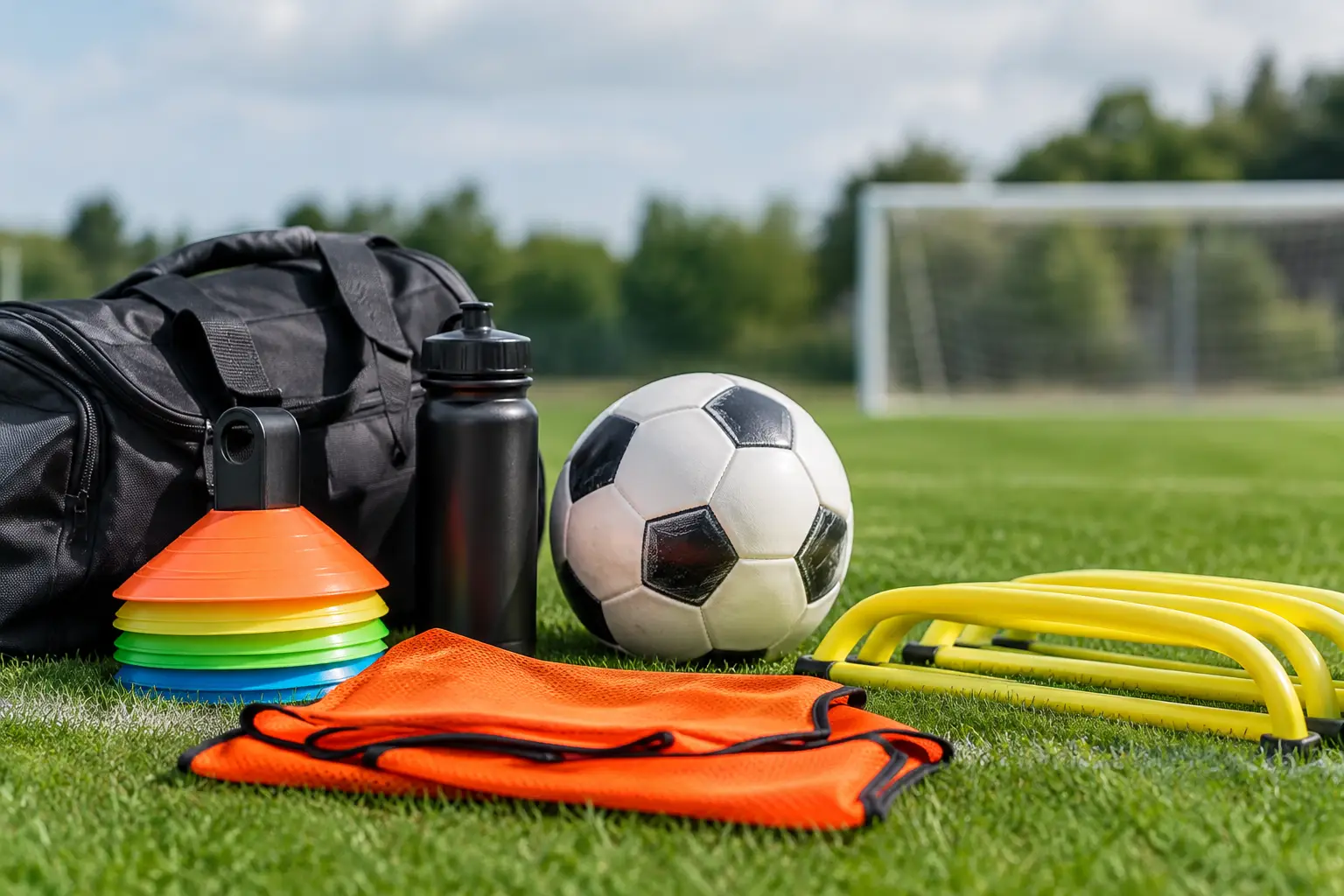
A slow, disorganised warm-up costs more than a few minutes before training. Players touch the ball less, coaches spend the opening block searching for gear, and the standard drops before the first proper drill begins. A reliable football warm up equipment list removes that friction and gives every player a clear route into sharp, match-ready movement.
The goal is not to carry every piece of kit you own. It is to bring equipment with a defined job: organise the group, prepare the body, create quality football actions and support confident movement in boots. The right setup changes with squad size, surface and session objective, but the essentials stay consistent.
Football warm up equipment list: the core kit
For most team sessions, one well-packed gear bag should cover the opening 15 to 25 minutes. Start with the items that keep players moving rather than waiting.
- Football balls: Bring enough quality balls to avoid long queues. A practical target is one ball between two players for technical work, with extras for passing patterns and finishing preparation. Check pressure before leaving home. A flat ball ruins first touch work and wastes valuable time.
- Flat disc markers: These are the foundation of a flexible warm-up area. Use them to set grids, passing gates, turning zones and lanes without creating a trip hazard. Bright colours are easier to see on grass, turf and low-light winter evenings.
- Cones: Taller cones give players clear reference points for changes of direction, slalom runs and larger activation spaces. They are useful, but do not replace disc markers. Use cones where visibility matters and discs where players need to move freely.
- Bibs: Separate groups quickly for possession games, pressing work or competitive warm-up finishes. Carry more than two colours when possible, especially for academy groups or mixed squads. Clean, dry bibs are a small detail that makes the session feel organised.
- Mini hurdles: Low hurdles prepare ankle stiffness, knee drive and coordination when used with control. They are not a test of how high a player can jump. Keep the height low and the contacts clean, particularly early in the session.
- Agility poles or slalom poles: Poles provide a stronger visual target than cones for curved runs, body positioning and deceleration. Use a small number. An overcrowded pattern can look impressive but often creates poor movement quality.
- Resistance bands: Light bands work well for individual activation around the hips, glutes and ankles. They are most useful when players already know the exercises and can complete them without holding up the group.
A whistle and a stopwatch are also worth having, although neither should become the centre of the warm-up. Clear demonstrations, properly marked spaces and a consistent routine usually do more for tempo than constant noise from a whistle.
Build the equipment around the warm-up phases
The best equipment list follows the sequence of the session. Players should progress from general movement to football-specific actions, not jump straight into hard cuts or long passing.
Start with movement and awareness
Set out a clean grid using flat markers. This is where players can raise body temperature with light running, mobility patterns, scanning cues and simple ball touches. A ball each or one between two is ideal at this stage because it gives players repeated contact without demanding full intensity.
Keep the area realistic for the group. If 16 players are squeezed into a tiny square, touches become rushed and players start avoiding collisions rather than preparing well. If the space is too large, the work loses its purpose. Adjust the grid before the session begins rather than stopping midway to fix it.
Add coordination and controlled change of direction
Mini hurdles, cones and poles belong in the next phase. Use them to rehearse efficient foot placement, controlled acceleration and balanced deceleration. The emphasis is posture: hips stable, chest controlled, short ground contacts and a strong first step out of the pattern.
This is where coaches can make an easy mistake. Complex ladder-style patterns may look busy, but they do not automatically transfer to football. A simple hurdle sequence followed by a five-metre acceleration and a pass is often more useful than a long choreography drill with no ball or decision.
Finish with football actions at relevant speed
The final warm-up block should look increasingly like the session or match ahead. Create passing gates with cones, use bibs for a tight rondo, or organise a short possession game in a marked area. Players should scan, receive on different feet, communicate and accelerate with purpose.
For a matchday warm-up, add a few progressive sprints and position-specific actions. Wide players may need sharp changes of pace and crossing movements. Central players can rehearse receiving under pressure and playing forward. Defenders benefit from backpedal-to-sprint actions and quick body adjustments. Keep the volume low enough that players arrive at kick-off primed, not fatigued.
Boots, socks and traction are part of preparation
Equipment on the grass matters, but what players wear matters just as much. Boots should suit the surface and conditions. Firm ground boots can feel unstable on wet natural grass, while the wrong soleplate on artificial turf can affect confidence when turning and stopping.
Grip socks are a practical matchday essential for players who want a more secure connection between foot, sock and boot. Reduced internal movement can help the boot feel more locked in during accelerations, cuts and repeated changes of direction. Fit still matters. Socks that bunch at the heel or feel too tight around the calf will distract from the warm-up rather than support it.
At Pro Pitch Football, the focus is on football essentials that support secure movement and match-ready preparation. The same standard should apply to every item in the bag: gear must earn its place through function, not just because it looks professional.
Scale the list for your group and surface
A senior squad training on a full pitch needs a different setup from a small technical session on a compact artificial surface. More players require more balls, more markers and enough bib colours to create clear teams. A goalkeeper-specific block may also require gloves, spare balls and a few taller cones for handling and footwork patterns.
Surface changes the equation too. On a windy grass pitch, heavier cones and visible markers are more reliable. On artificial turf, flat discs are useful because they stay low and reduce the chance of catching a boot. In wet conditions, pack a towel, spare socks and a dry place for small equipment. These details protect session quality when conditions are not ideal.
Avoid building a kit list around novelty. Speed parachutes, reaction lights and specialist tools can have a place in certain programmes, but they are not replacements for balls, markers, cones and a well-planned progression. If an item adds setup time without improving the intended action, leave it out.
Pack, check and reset after every session
Preparation starts before players arrive. Inflate balls, count bibs, inspect bands for tears and remove cracked cones from rotation. Store small items in separate bags so markers, bands and pump needles do not disappear into the bottom of a large kit bag.
After training, collect equipment with the same discipline. A quick count prevents the familiar problem of discovering missing balls and bibs five minutes before the next session. Letting players help pack down also reinforces that standards are shared across the group.
A strong warm-up does not need complicated equipment. It needs reliable essentials, enough space to move properly and a setup that lets players focus on the next action. Pack for the session you are running, prepare every item before you reach the pitch, and make the first 20 minutes set the standard for everything that follows.