
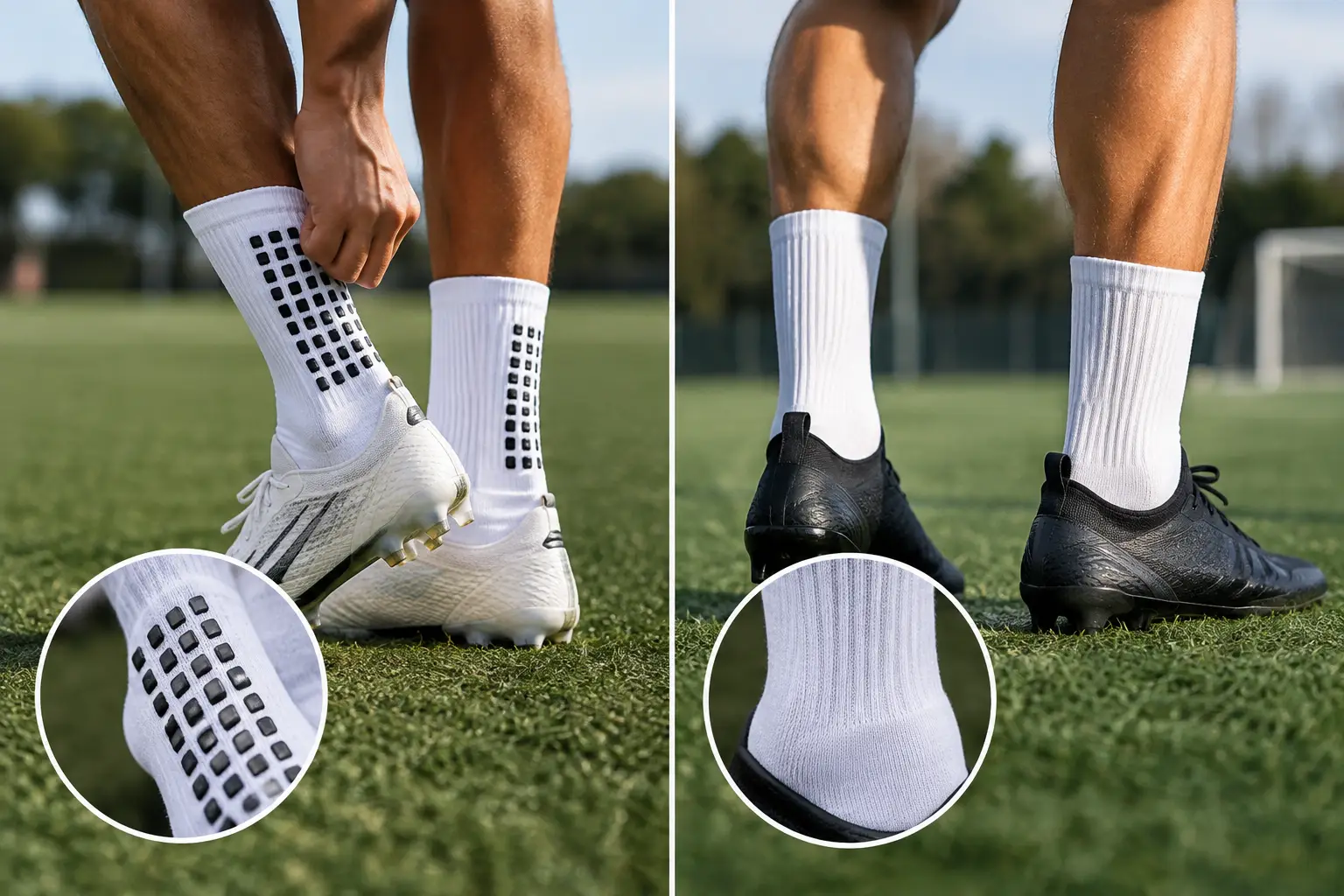
A hard change of direction, a late tackle or a wet pitch can expose the gap between grip socks versus regular socks. When your foot slides inside the boot, you lose more than comfort. You can lose stability, confidence and the clean contact needed to play at speed.
For committed footballers, socks are not an afterthought. They sit between your foot and your boots for every sprint, press, strike and recovery run. The right option depends on how you train, how your boots fit and whether you need a simple everyday layer or a more secure match-day setup.
Grip Socks Versus Regular Socks: The Core Difference
Regular socks create a soft fabric layer between the foot and the boot. They are suitable for general wear, light training and players whose boots already fit securely. Most standard football socks are designed to meet team uniform requirements, provide basic coverage and manage some moisture. They are not specifically built to prevent movement inside the boot.
Grip socks use grip elements on the sole, and often around key contact areas, to reduce slipping between the sock, insole and boot. The goal is not to make your foot immovable. Your foot still needs to work naturally through the stride. The purpose is to limit unwanted movement when you push off, decelerate or change direction.
That difference matters most during high-intensity football actions. If your heel lifts or your foot shifts sideways inside the boot, the boot responds a fraction later than your body. Over a full session, that movement can also contribute to friction and hot spots.
Why Internal Boot Movement Affects Performance
Football is played through repeated explosive actions. You accelerate over short distances, plant one foot to turn, strike through the ball and absorb force when landing. A secure boot-to-foot connection helps those movements feel more direct.
Grip socks can improve that connection by reducing the small slides that happen inside the boot. Players often notice the difference first when cutting sharply or sprinting from a standing start. The foot feels more planted, particularly in boots that have a slightly roomier fit or have softened with use.
There is also a comfort benefit. Repeated friction is one of the main causes of blisters. By limiting rubbing, a well-fitted grip sock can help reduce friction around the heel, toes and side of the foot. It is not a guarantee against blisters - poor boot fit, wet conditions and worn insoles still matter - but it can remove one common cause.
Regular socks can still feel comfortable, especially in properly fitted boots. However, as training intensity rises, their smooth fabric is more likely to move against the insole or allow the foot to move within the boot.
When Regular Socks Are Enough
Regular socks are not automatically the wrong choice. For a casual kickabout, recovery session or low-intensity gym work, standard socks are often perfectly practical. They are easy to replace, familiar to wear and generally work well when the boot fit is already close and secure.
They can also suit players who prefer a thinner feel. Adding grip socks changes the volume inside the boot, even when the material itself is lightweight. If your boots already feel tight across the forefoot or toes, switching socks without checking the fit can create pressure rather than improve control.
Team socks are another consideration. Most clubs require a specific sock colour and design on match day. Many players wear grip socks beneath their team socks or use a cut-sock setup, depending on club expectations and competition rules. Always make sure your match kit remains compliant and secure before kick-off.
When Grip Socks Make More Sense
Grip socks are built for players who train and compete with intent. They are especially useful if you notice heel lift, your feet sliding during sharp turns, or blisters after demanding sessions. They can also help when boots loosen slightly after being broken in.
They are a strong option for:
- match days and high-intensity team training
- players who rely on rapid changes of direction
- boots with a little extra internal room
- wet-weather sessions, when moisture can increase movement
- players managing recurring friction at the heel or forefoot
Position does not decide the choice on its own. A winger may value a locked-in feel for acceleration, while a midfielder may notice it during constant pressing and turning. Defenders and goalkeepers also make explosive lateral movements. The real question is whether your foot stays stable in the boot when the session reaches match pace.
Fit Matters More Than the Grips
Grip technology cannot fix a boot that is too big, too narrow or past its best. Start with a boot that holds the heel securely, gives the toes enough room and does not cause pinching through the midfoot. Then use your sock choice to refine the fit.
A grip sock should sit close to the foot without bunching at the heel or toes. Excess material can create pressure points and cancel out the benefit of the grip. If the sock feels restrictive, leaves deep marks or makes your boots uncomfortably tight, reconsider the size or the overall boot fit.
Thickness is personal. Some players prefer a thin, close-to-the-boot feel. Others want more cushioning for firm pitches or long sessions. Neither is universally better. The right thickness is the one that gives you security without taking away touch or comfort.
Test your setup in training before relying on it in a match. Wear the same boots, shin pads and outer socks you intend to use on game day. A few accelerations, turns and ball-striking drills will tell you more than walking around the house ever will.
Comfort, Moisture and Durability
A football sock needs to handle sweat as well as movement. When fabric holds moisture, the foot can slide more easily and skin becomes more vulnerable to rubbing. Look for a performance-focused construction that feels breathable and stays shaped through repeated sessions.
Regular socks vary widely. Some are thin and quick-drying, while others are made primarily for warmth or everyday comfort. A casual cotton sock may feel fine at the start of training but hold moisture as the session continues. That is less useful when you are working through repeated sprints on a humid afternoon or playing through rain.
Grip socks also need care. Turn them inside out before washing where possible, use a cool wash and avoid high heat. Heat can affect stretch fibres and may reduce the life of grip elements over time. Rotate more than one pair if you train several days a week, rather than relying on a single pair until it wears out.
Are Grip Socks Worth It for Football?
For players who train regularly and compete at a serious level, grip socks are usually a practical upgrade. They do not add pace, fix technique or replace quality boots. What they can do is reduce internal movement, support a more consistent fit and help you focus on the next action rather than what your feet are doing inside your boots.
The value is clearest when you already have the fundamentals sorted: boots that fit, laces secured properly and socks suited to your conditions. In that setup, grip socks become a small piece of equipment that supports repeatable movement.
Pro Pitch Football grip socks are designed around that purpose: secure footing, close fit and reliable comfort for football sessions that demand more from your gear.
Before your next hard session, assess your boots honestly. If you are tightening laces constantly, feeling heel lift or finishing training with friction marks, your socks may be the simplest part of the setup to improve.