
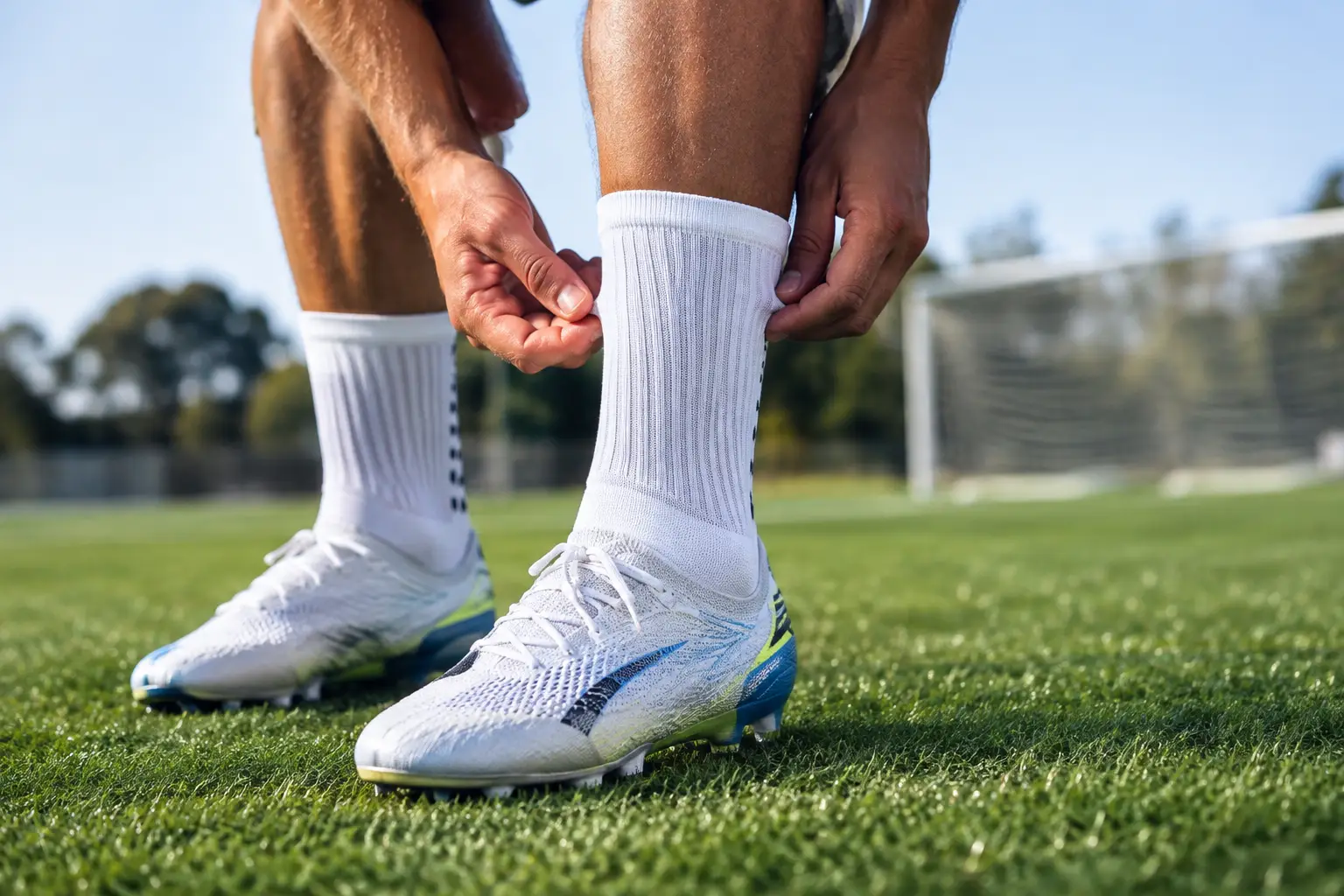
A sock that slides inside your boot can ruin a sharp first touch, create a hot spot on your heel and make every change of direction feel less secure. To prevent football sock slippage, treat your socks as performance equipment, not an afterthought. The right combination of fit, boot setup and grip can keep your foot locked in from warm-up to the final whistle.
Why football socks slip in the first place
Sock slippage usually starts with movement between three surfaces: your foot, the sock and the inside of the boot. If one layer is loose, wet, worn or poorly matched to the others, it starts to bunch or slide. Once that movement begins, friction increases. That is when blisters, pressure points and loss of confidence follow.
A boot that is slightly too large is a common cause. Players often blame their socks when the real issue is heel lift or excess space through the forefoot. Your foot should feel secure in the boot without your toes being cramped. If you can feel your heel moving up and down when accelerating, sock changes alone will only do so much.
Moisture is another factor. Hard sessions, wet pitches and humid conditions can saturate standard cotton socks quickly. As fabric gets wet, it becomes heavier and less stable. It can also reduce the hold between your foot and the boot lining.
Finally, check the condition of your socks. Elastic weakens over time, especially if socks are washed at high temperatures or dried aggressively. A stretched sock may look fine in the kit bag but lose shape once you start running.
Start with the correct sock and boot fit
A secure setup begins before tape or grip technology enters the picture. Choose socks that match your foot size closely. Football socks should sit flat across the toes and heel, with no spare fabric at the front. Excess material folds under the foot and creates the movement you are trying to avoid.
If you wear an inner grip sock with an outer team sock, make sure neither layer is too tight or too loose. The inner sock should fit snugly across the arch, heel and ankle. The outer sock needs enough stretch to sit over it without pulling the inner layer out of position. If it is overly tight, it can restrict circulation and create uncomfortable pressure around the calf.
Your boots also need an honest fit check. Try them on with the exact socks you train and play in, not thin everyday socks. Lace the boots fully, jog, cut and strike a few passes. Pay attention to heel lift and whether your foot slides forward when stopping. A secure boot fit gives every other part of your setup a better chance of working.
Choose materials that manage moisture
Cotton-heavy socks can feel comfortable at first, but they tend to retain sweat. Performance football socks generally use synthetic fibres that move moisture away from the skin and dry faster. This helps maintain a more consistent fit through a full session.
The goal is not to make your foot completely dry in every condition. Wet-weather football is wet-weather football. The goal is to stop moisture from turning your sock into a loose, shifting layer inside the boot.
Use grip socks for a more stable base
Grip socks are designed to reduce internal foot movement. Their grip elements create additional hold between your foot and the sock, and between the sock and your boot. For players who train several times a week or play at a high tempo, that added stability can make a real difference in comfort and confidence.
They are particularly useful if you rely on quick accelerations, sharp turns and repeated changes of direction. Wingers, fullbacks and midfielders may notice the benefit quickly, but any player can use them to reduce unwanted movement inside the boot.
A quality pair should feel secure without feeling bulky. If grip socks make your boots feel too tight, do not simply force the setup. It may mean the socks are too thick for that boot, the boot is already a close fit, or you need a different size. Performance gear should support your movement, not create a new distraction.
Pro Pitch Football grip socks are built for players who want a locked-in feel under match socks without adding unnecessary fuss to their routine.
Secure the outer sock without over-tightening
When players wear grip socks under their team socks, the outer layer can slide down or separate. Sock tape is a practical way to hold the outer sock in place, particularly when you have cut the foot section from a team sock to wear it as a sleeve over grip socks.
Apply tape around the lower calf or just above the ankle, depending on where the outer sock needs support. Keep it firm enough to stop movement but never so tight that it leaves deep marks, causes tingling or restricts circulation. You should be able to move freely through your ankle range while still feeling supported.
Use tape to secure fabric, not to compress your leg. If you need several tight layers to keep your sock up, the sock may be worn out or the wrong size. Replacing it is the better fix.
For matches, check your competition rules and team requirements. Some teams require tape that matches the colour of the sock, and officials may ask players to cover contrasting layers. Sort this out before kick-off, not while the referee is waiting.
Build a match-day routine that stops movement
The most reliable way to prevent football sock slippage is to repeat the same setup in training and matches. Do not save a new pair of grip socks, a different tape method or freshly bought boots for an important fixture. Test your full system during a demanding session first.
Put your kit on in the same order each time. Start with clean, dry feet. Pull on your grip socks so the heel pocket is correctly aligned, then smooth the fabric from toe to ankle. Add your outer sock or sleeve without twisting it. Tape only after both layers are flat and positioned correctly.
Lace your boots with purpose. Tighten from the toes upward, then lock the laces through the top eyelets if your boots have them. This can reduce heel lift without crushing the top of your foot. Retie your laces after the warm-up if needed, as boots and socks can settle once you start moving.
Keep a spare pair of socks in your bag for wet sessions and match days. Changing out of soaked socks at half-time is not always necessary, but it can help when the pitch is heavy, rain is persistent or you feel friction building. A dry pair is a simple reset that may prevent a blister from becoming a problem.
Avoid fixes that create bigger problems
Doubling up on thick socks may feel like an easy answer, but it often makes the boot tighter and reduces touch sensitivity. It can also trap heat and cause more sweat. Extra padding is only useful if your boots have too much volume, and even then, it is usually better to address the fit rather than build layers inside the boot.
Do not use adhesive sprays, random household tape or makeshift materials on your skin. These can irritate your feet, damage your socks or leave residue inside your boots. Stick to equipment designed for football use.
Also avoid playing through persistent rubbing. A small hot spot can become an open blister quickly, especially during preseason sessions or tournament football. Stop, adjust your sock and boot setup, and protect the area before it affects your training load.
When sock slippage is really a boot problem
If your socks still slide after you have improved fit, changed materials and secured the outer layer, reassess the boots. Worn heel linings, stretched uppers and a poor boot shape can all let the foot move too much. Boots do not need to be falling apart to lose their secure feel.
Different boot models suit different foot shapes. A player with a narrow heel may need a more locked-in heel counter, while a wider forefoot may need extra room without sizing up overall. Finding that balance matters more than chasing the lightest or most popular boot.
Your kit should disappear into your game. When your socks stay in place, your boots feel secure and your feet stay comfortable, you can focus on receiving under pressure, driving past an opponent and finishing the next action properly.